Gaussian
Gaussian
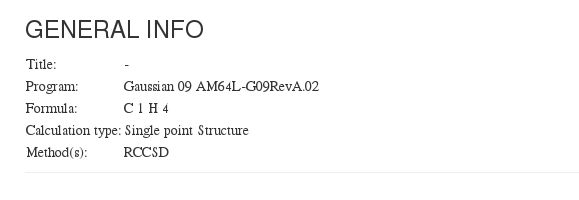
General Info
Gaussian - General Info - Main fields
| Field | Source | Sample value |
|---|---|---|
| Title | Set on Browse calculation publication | Sample calculation |
| Browse Item | URL pointing Browse published item | https://iochem-bd.iciq.es/browse/handle/100/1722 |
| Program | <scalar dictRef="cc:program"> <scalar dictRef="cc:program"> | Gaussian 09 |
| Author | Username fullname | Doe, John |
| Formula | Atom count from final geometry | H 1 O 40 P 1 Ti 1 W 11 |
| Calculation type | Custom logic 1 | Geometry optimization Minimum |
| Method | DFT | DFT |
string
gaussian:getCalcTypebooleanisOptimizationbooleanhasStationaryPointbooleanhasMinimumbooleanisEET↩︎$isOptimization Exists module <module cmlx:templateRef="l103" > ? $hasStationaryPoiny 'Stationary point found' appears in <module cmlx:templateRef="l103.optimizedparam" > ? $hasMinimum 'Search for a local minimum' appears in <module cmlx:templateRef="l103.localminsaddle" > ? $isEET Exists module <module cmlx:templateRef="l925" > ? <!-- Calculation type related constants --> <xsl:param name="isOptimization" as="xs:boolean"/> <xsl:param name="hasStationaryPoint" as="xs:boolean"/> <xsl:param name="hasMinimum" as="xs:boolean"/> <xsl:param name="isEET" as="xs:boolean"/> <xsl:choose> <xsl:when test="$isEET"> <xsl:sequence select="'Excitation energy transfer'"/> </xsl:when> <xsl:otherwise> <xsl:variable name="calcType" select="if($isOptimization) then 'Geometry optimization' else 'Single point'"/> <xsl:choose> <xsl:when test="$hasStationaryPoint"> <xsl:variable name="hasMinimum" select="if($hasMinimum) then ' Minimum' else ' TS'"/> <xsl:sequence select="concat($calcType, ' ' , $hasMinimum)"/> </xsl:when> <xsl:otherwise> <xsl:sequence select="concat($calcType, ' Structure')"/> </xsl:otherwise> </xsl:choose> </xsl:otherwise> </xsl:choose>
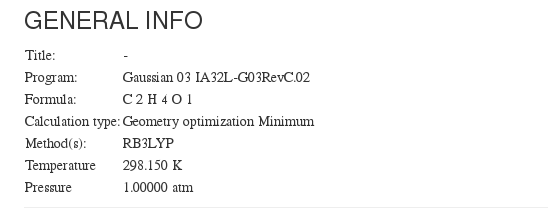
Gaussian - General Info with additional fields (if thermochemistry module exists)
| Field | Source | Sample value |
|---|---|---|
| Temperature | <scalar dictRef="cc:temp"> | 298.15 K |
| Pressure | <scalar dictRef="cc:press"> | 1.0 atm |
General Info - HTML example/s
General Info with thermochemistry- HTML example/s
Atoms and Basis Sets
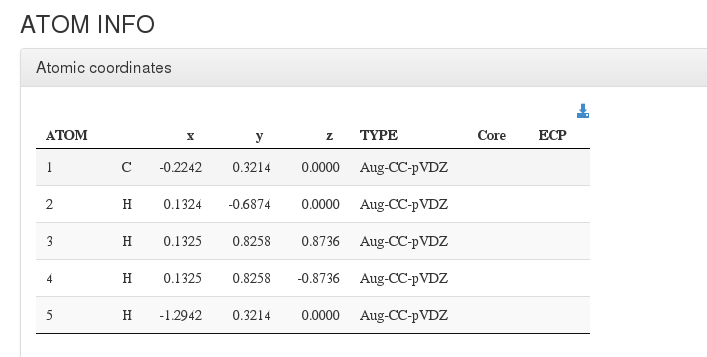
After header section, our HTML resume will output a xyz coordinates table with current molecule atoms.
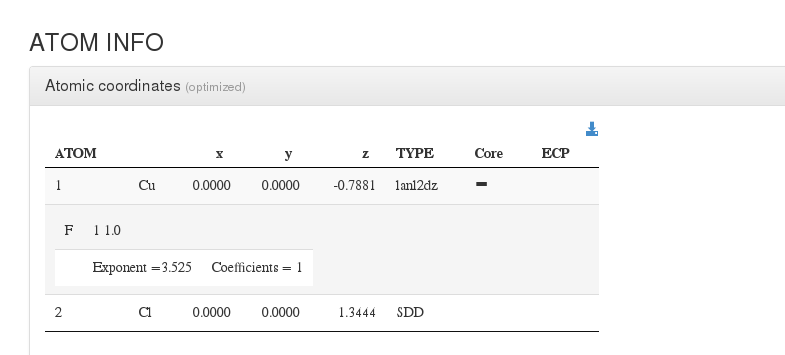
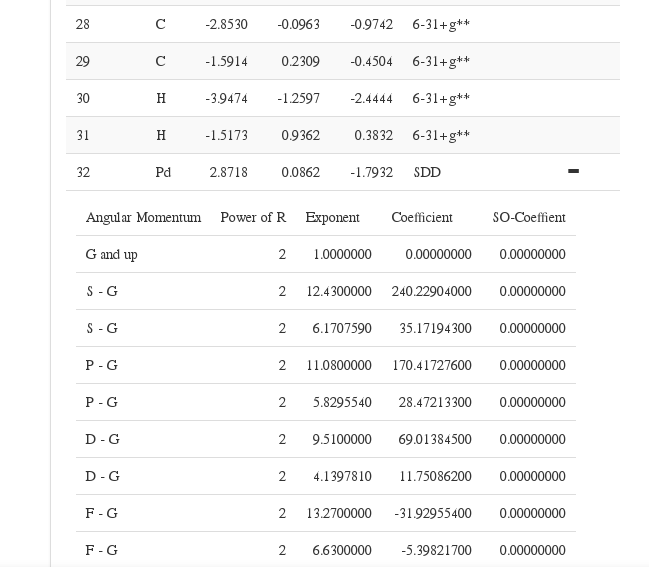
For every atom, we will output it's serial number, atom type, coordinates in angstroms, basis used and core, or simply basis.
In geometry optimizations calculations, next to geometry section header there will appear the word (optimized), pointing that this geometry is the last one from all optimization steps and has converged.
If the geometry optimization did not converge, there will appear the phrase (calculation did not converge).
If there are multiple geometries we'll capture it's last appearance.
Atomic coordinates - HTML example/s
Atomic coordinates - (with core section) - HTML example/s
Atomic coordinates - (fragment with ecp section) - HTML example/s
Molecular Info
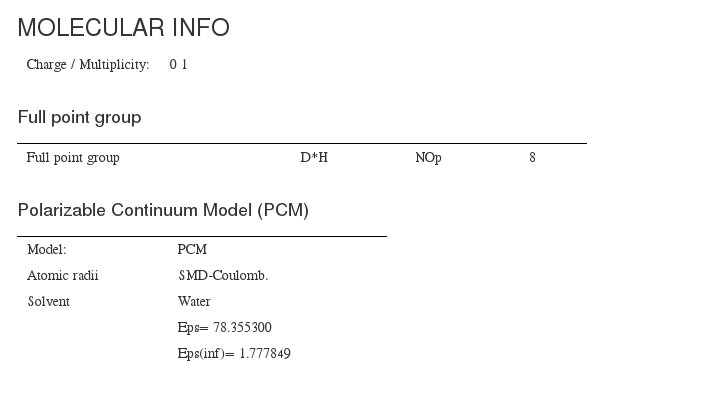
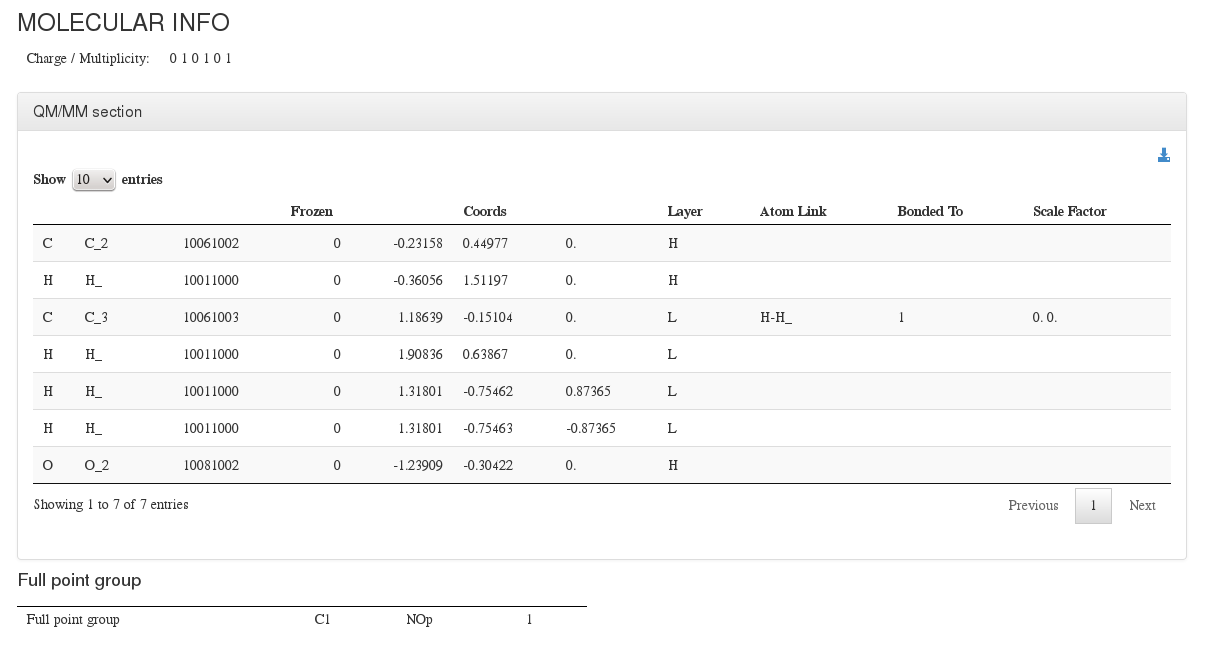
This section captures molecule additional information not captured on previous section.
Molecular Info - Main fields
| Field | Source | Description |
|---|---|---|
| Multiplicity | Appears in
| |
| Charge | It can appear on same places that multiplicity field and also in l9999.archive module | |
| QMMM | <module cmlx:templateRef="l101.qmmm"> | |
| Frozen section | <module cmlx:templateRef="l101.modredundant"> | |
| Point group | <module cmlx:templateRef="l202.stoich"> | |
| Solvation | <module cmlx:templateRef="l301.pcm.standard"> | Solvation parameters |
Molecular Info - HTML example/s
Molecular Info with QM/MM section - HTML example/s
Modules
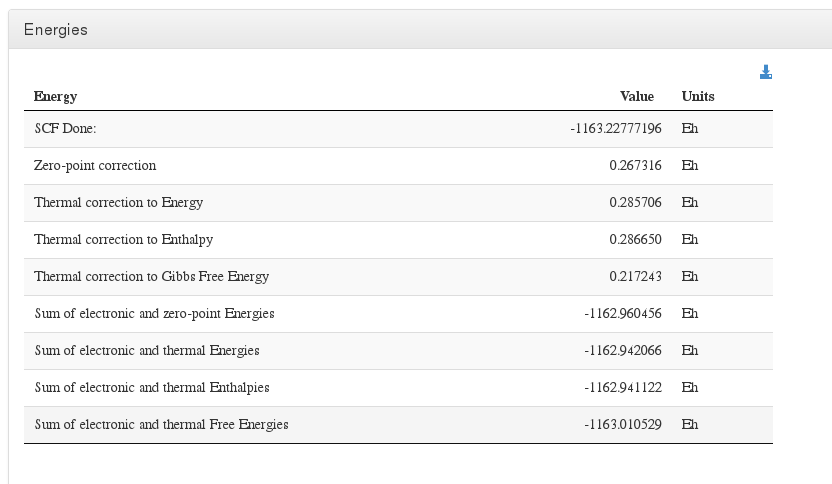
Energies
Data source: <scalar dictRef='g:rbhflyp'>
Data source: <scalar dictRef='cc:dispenergy'>
Data source: <module cmlx:templateRef='l120'>
Data source: <module cmlx:templateRef='l122'>
Data source: <module cmlx:templateRef='l716.zeropoint'>
Data source: <module cmlx:templateRef='l9999.archive'>
Energies - HTML example/s
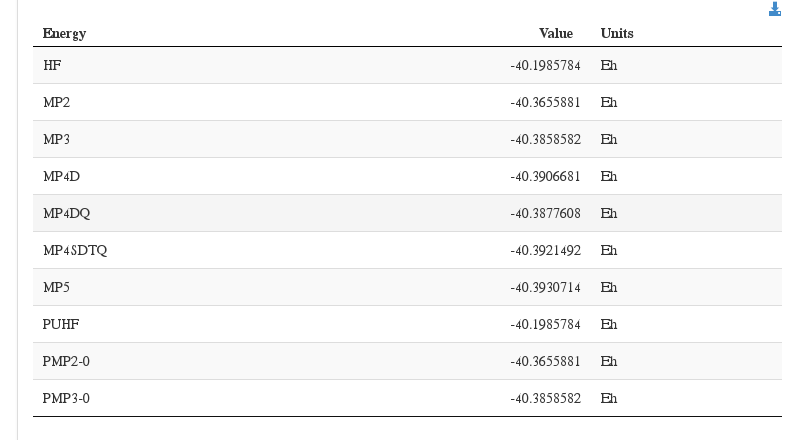
Energies 2 - HTML example/s
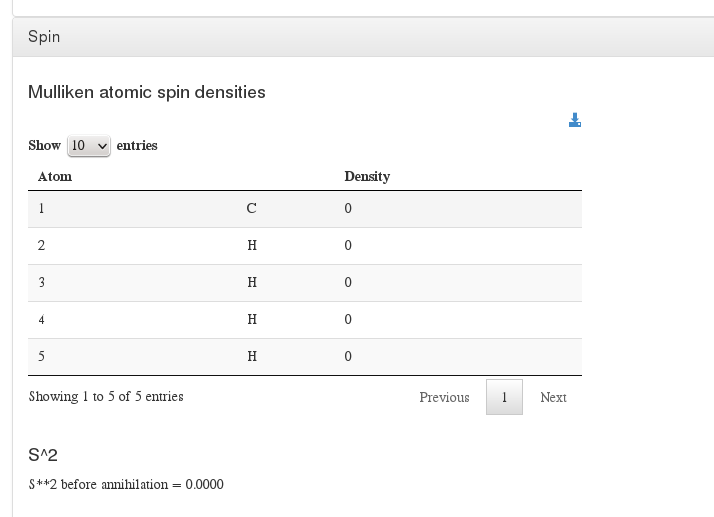
Spin
Data source: <module cmlx:templateRef='l601.mullikenspin'>
Data source: <scalar dictRef='cc:spincontamination'>
Mulliken atomic spin densities / S**2 - HTML example/s
IR spectrum
Data source: <module cmlx:templateRef='l716.freq.chunkx'>
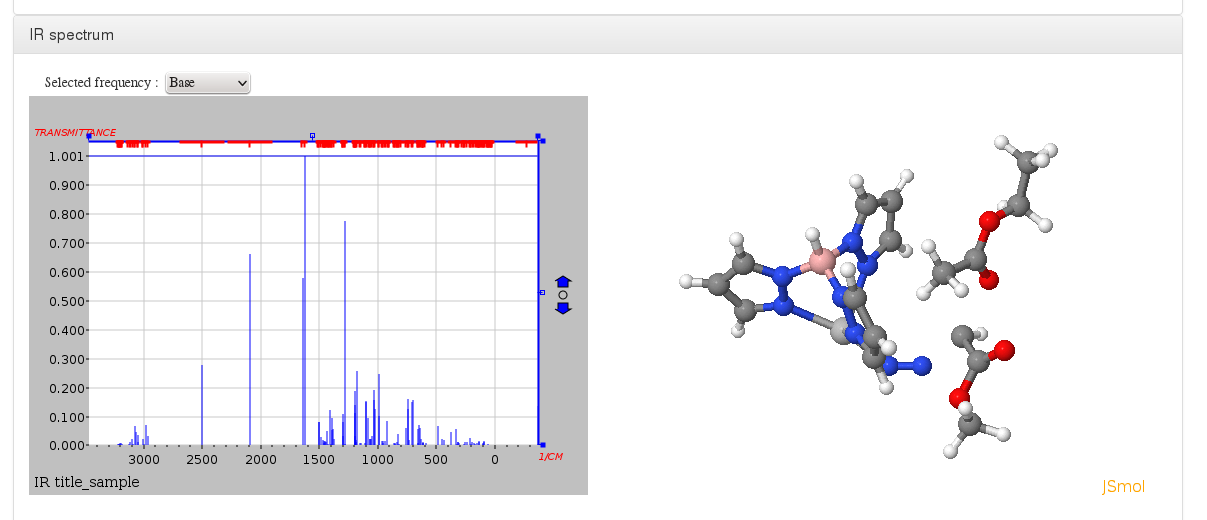
This module will display JSpecView + JSmol plugins (using javascript libraries) working together to represent molecule IR spectrum.
IR spectrum - HTML example/s
Mulliken atomic charges
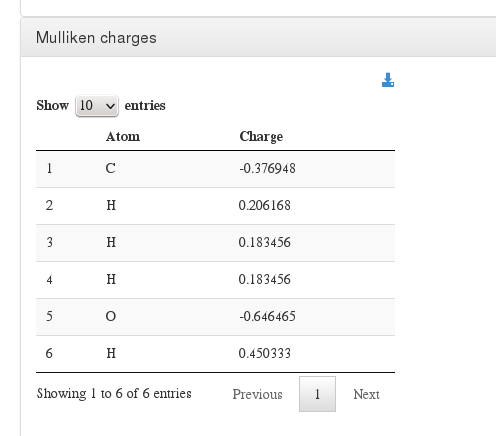
Data source: <module cmlx:templateRef='mulliken'>
Mulliken atomic charges - HTML example/s
Dipole / Multipole moment
Data source: <module cmlx:templateRef="multipole">
Dipole / Multipole moment - HTML example/s

Electronic coupling for Excitation Energy Transfer
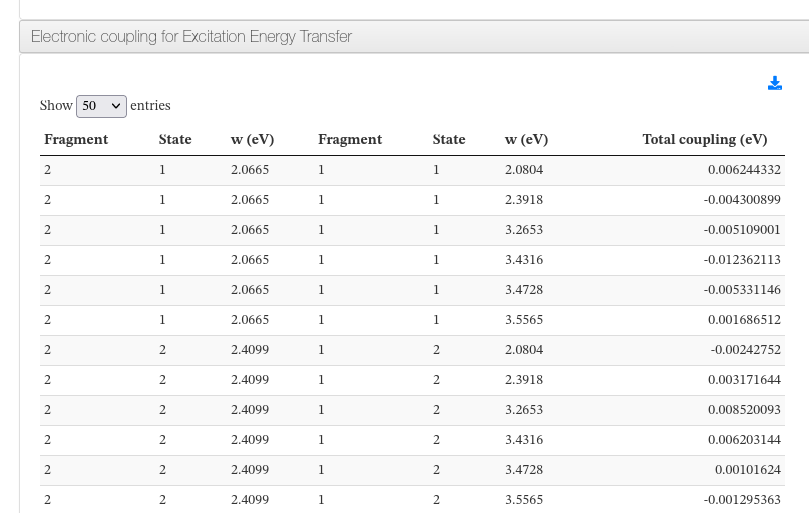
Data source: <module cmlx:templateRef="l925">
Electronic coupling for Excitation Energy Transfer - HTML example/s
Final Excitation Energies
Data source: <module cmlx:templateRef='l914'>
Final Excitation Energies - HTML example/s

Intrinsic Reaction Coordinate
Data source: <module cmlx:templateRef='l123'>
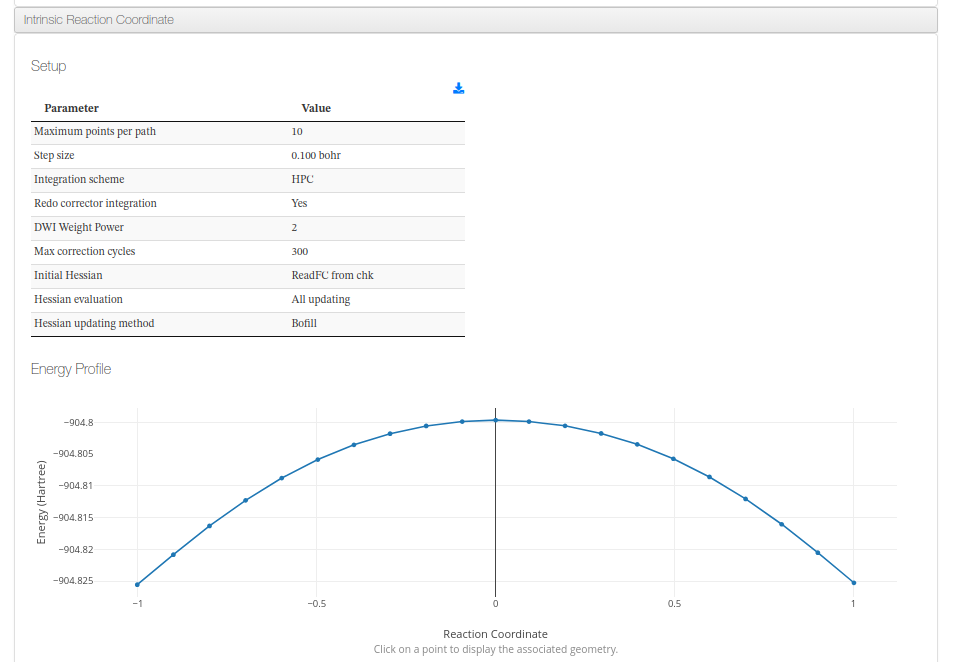
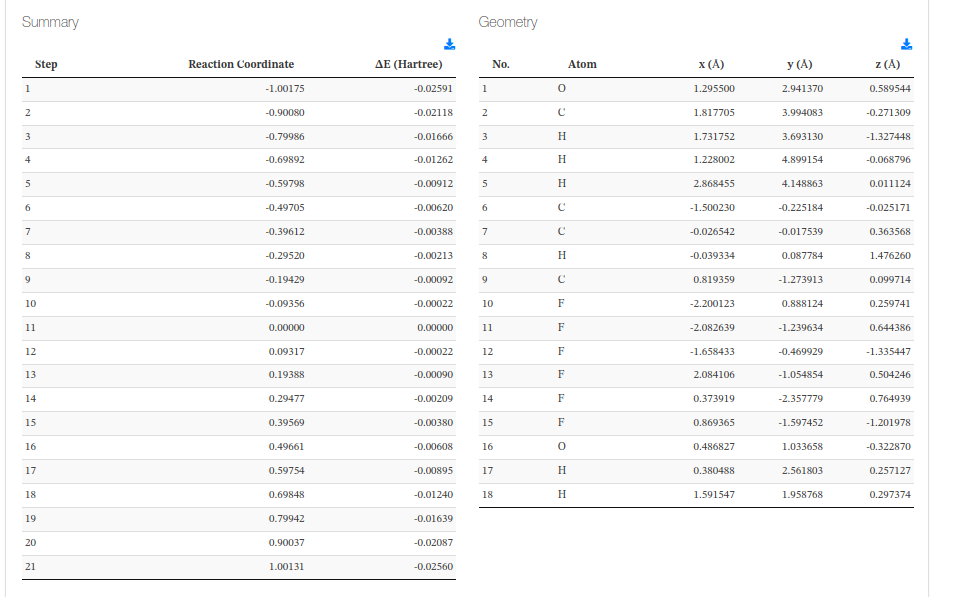
This section presents the results of an Intrinsic Reaction Coordinate (IRC) calculation, which traces the minimum energy path connecting the transition state to reactants and products.
It is organised into four sub-sections:
Setup: A table summarising the IRC calculation parameters, such as step size, maximum number of path points, integration scheme, and Hessian settings.
Energy Profile: An interactive plot of total energy (Hartree) versus reaction coordinate. Clicking on any point along the curve displays the corresponding molecular geometry in the Geometry table.
Summary: A table listing, for each IRC point, the step index, reaction coordinate value, and energy relative to the transition state (ΔE in Hartree).
Geometry: A table of Cartesian coordinates (Å) for the molecular geometry at the IRC point selected in the Energy Profile plot.
IRC - HTML example/s